My very first trip to Europe was in 2005 ~~ thank you, Lucrezia Bori Grant from The Juilliard School ~~ and my destination? Munich, Germany. With the support of this language study grant, I spent a beautiful month taking an intense German language course at the Goethe-Institut during the best time of the year, the Opernfestspiele. I would study German in the morning, attend a cultural event with the school every afternoon and attend a performance at night. Every time I have returned to this city, I think about the young lady who happily wandered around in 2005. Who knew that she would move to Germany 5 years later?
But that’s another blog post. I returned to Munich recently for a project and here are some new memories for the collection:
Englischer Garten
Battled the ice and snow for a few slow runs in the park. But with views like this, it was worth it.
Famous Chinesischer Turm
Built in 1790, the Chinese Tower is a pagoda-style, all-wooden tower that is 25-meters tall. The tower was destroyed during World War II in 1944 and restored to its original form in 1952. Normally this area is filled with Christmas markets and people but not this year…
Pandemic Pandas
A fun find one evening at a local (closed) Bavarian tavern.
Bachmaier Hofbräu
Anytime Music, really
I discovered a 24-hour rehearsal center in Munich. Entering the center/practice studios and making reservations are easily controlled with an app. At this rehearsal center, there are 3 studios available — 2 August Förster uprights and 1 Yamaha baby grand piano. The studios are soundproof (with options of connecting recording equipment in two of the rooms), provide cellphone charging centers and free wifi available. It is a cozy rehearsal center with one bathroom and a small waiting area in addition to its 3 practice studios. I visited this center 3 times and tried out all three rooms - Studio 2 with the baby grand is the best option.
Practicing during COVID: I made sure to clean the keys and piano bench adjuster before AND after practicing. I also practiced with a mask on. Apparently there are options to adjust the ventilations in the rooms but I did not experiment with those.
Visit to Blaibach, Germany
This town, located near the Czech border, has around 2000 inhabitants and is the home of a rather unique modern concert hall. This is not a photo of the exterior of the concert hall but its administrative office and home to its Intendant.
Hallo Herr Steingraeber.
I have never played a Steingraeber & Söhne piano before this special trip. This family-owned business makes its home in Bayreuth, Germany and recently celebrated its 200th anniversary. All instruments are individually handcrafted which means they only produce around 100-150 pianos a year.
Franz Liszt (1811-1886)
Eduard Steingraeber was the concert technician for Franz Liszt who was notorious for breaking grand pianos during performances. Eduard would often have to go out on stage and repair them, something he would later describe as “the worst moments of his professional life.” But he would learn from these experiences and strive towards building a piano that would be able to withstand the power of such virtuosos but also have a large color and sound palette.
Almost the same...
My childhood piano was a Schafer & Sons piano so seeing this made me smile.
Well, this piano was one of the most temperamental pianos I have ever played. I found its color palette to be quite extreme from top to bottom. From my research, I discovered that this company experiments with many color and sound options. They have created an option called the “Mozart Rail” in which key depth in the grand pianos is reduced to 8mm from the normal 10 mm. Therefore the distance from hammer to string is shortened to 36mm, making softer articulations possible, together with quicker repetition. It also gives the concert grand a more intimate sound, a Mozart-like silvery sound.
This piano did not have this option.
Isn't she lovely?
As we experimented with the height of the piano lid, I was surprised to be able to move it up and down with such ease. I highly doubted it was due to my upper body strength and later found out that they have built concert grands with a super-light, sound-projecting lid. Steingraeber & Söhne use materials from aircraft constructions to reduce the weight of the lid by more than 45 percent (!!!) and to enhance the lid’s ability to vibrate.
Looking out
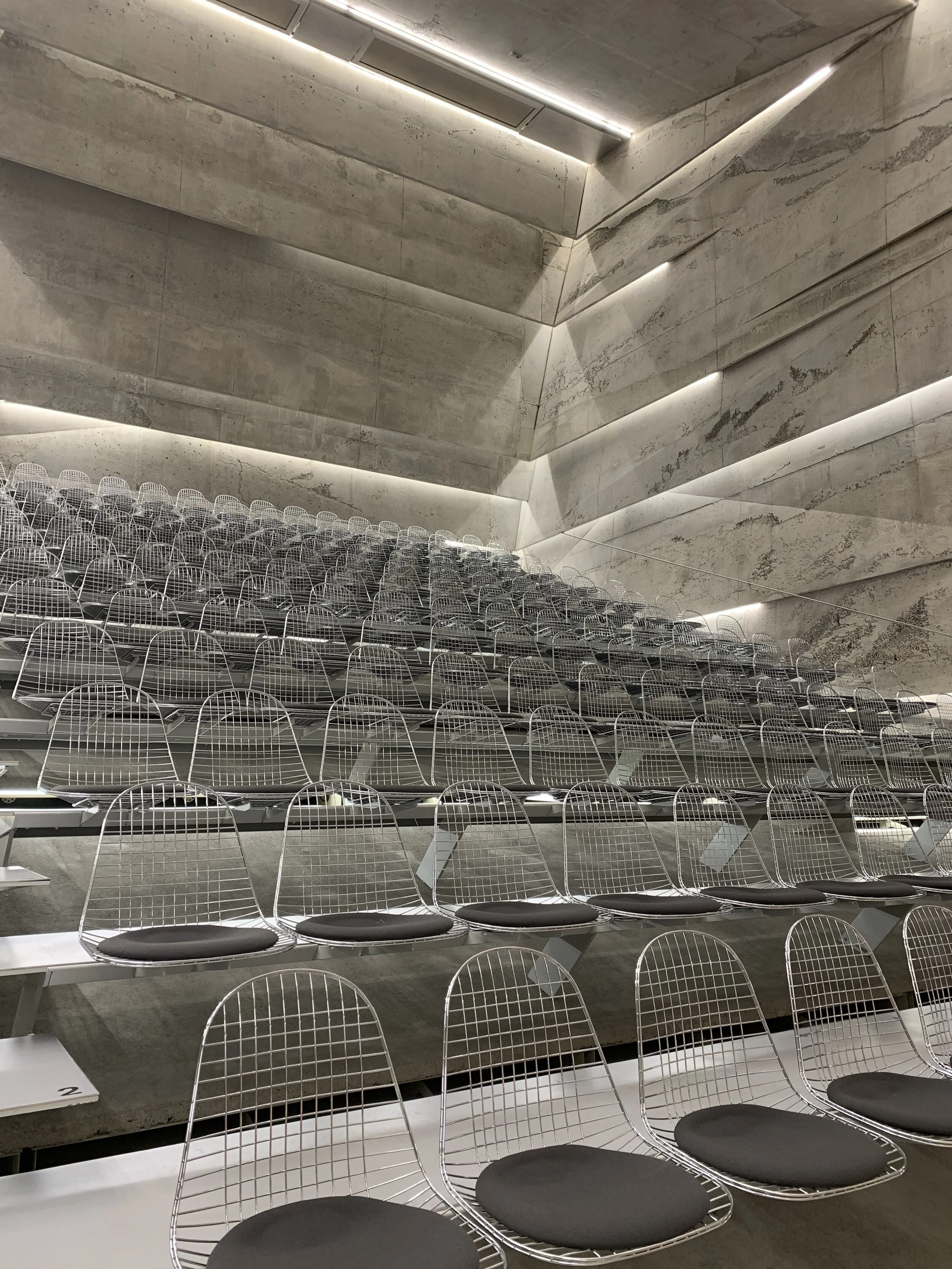
Fun facts about the Konzerthaus Blaibach:
* Architect is Peter Haimerl from München
* Built in 2014, it has 195 seats
* The stage is designed for 60 players
From the side
The walls are made from foamed glass mixed with raw untreated concrete. This hall is a very live one when it is empty. You can read more about its special architectural design and history here.
From one side
It was fun to discover a new performance venue and a new piano in a new part of Germany. I wish I had taken some pictures of its outer exterior as it is something you would not expect in the Bavarian woods. Pictures of its exterior and more information can be found here.
To be continued…